Tsiolkovsky's rocket equation
2024-10-09 17:00:46
I have always known that this equation existed, however I had 0 idea where it came
from.
a few months ago I was practicing physics problems for an interview that I had. one of the problems I came across was:
\[\textbf{ Find the amount of fuel needed for a rocket of mass $m$}\\ \textbf{ to escape earth's gravity.}\]
I started solving the problem, it was hard at first but eventually I was was able to solve it. When I arrived at the solution
I felt that it was oddly familiar. I looked at it and then it struck me.. it was Tsiolkovsky's rocket equation! now the
equation makes sense!!
here is the full explanation:
\[
\text{We assume the initial velocity to be $v_i$ , and final velocity to be $v_f$.}\\
\text{we consider two timeframes: $t$ and $t+ Δt$}
\]
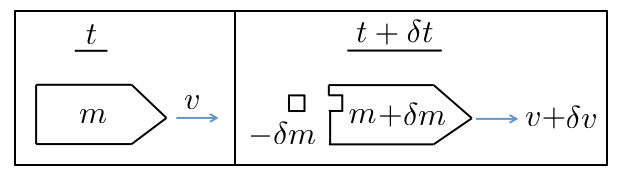 \[
\text{if we consider that at time $t$ the rocket is moving at velocity $v$ and has mass $m$, we }\\
\text{can then infer that at time $t = t+Δt$ the rocket has velcoty $v+Δv$, mass $m+Δm$} \\
\text{ and the fuel it expelled from the back has mass $-Δm$, and velocity $(-v_p+(v+Δv))$}\\
\text{where $v_p$ is the velocity at which propellant is expelled. } \]
\[
\text{if we consider that at time $t$ the rocket is moving at velocity $v$ and has mass $m$, we }\\
\text{can then infer that at time $t = t+Δt$ the rocket has velcoty $v+Δv$, mass $m+Δm$} \\
\text{ and the fuel it expelled from the back has mass $-Δm$, and velocity $(-v_p+(v+Δv))$}\\
\text{where $v_p$ is the velocity at which propellant is expelled. } \]
\[ \text{using the law of conservation of momentum:}\\[0.5em] m*v = (m+ \Delta m)(v + \Delta v) + (- \Delta m)(-v_p+(v + \Delta v))\\[1.5em] \text{expanding the brackets we get:}\\[0.5em] m*v = mv + m \Delta v + \Delta m v+ \Delta m \Delta v - (-\Delta m v_p) - \Delta m v - \Delta m \Delta v \\[1.5em] ~rearranging~we~get: \\[0.5em] m \Delta v - \Delta m v_p = 0 \rightarrow m \Delta v = -\Delta m v_p\\[0.5em] \frac{\Delta m}{m}=\frac{\Delta v}{-v_p}\\[1.5em] \text{instead of writing Δ which usually signifies a large change, we can just use $d$ which} \\[0.5em] \text{ signifies a change where Δ→0. we use separation of variables to get:}\\[0.5em] \int_{m_i}^{m_f} \frac{\mathrm{d}m}{m} = \int_{v_i}^{v_f}\frac{\mathrm{d}v}{-v_p}\\[0.5em] \left. \ln(m) \right|_{m_i}^{m_f} = \frac{1}{-v_p} *\left.v \right|_{v_i}^{v_f}\\[0.5em] \ln(m_f)-\ln(m_i)= \frac{\Delta v}{-v_p} \rightarrow \, \, \ln(m_i) - \ln(m_f)= \frac{\Delta v}{v_p}\\[0.5em] \boldsymbol {\Delta v=v_p*\ln(\frac{m_i}{m_f})}\\[1.5em] \] \[\textbf{there we go, this is Tsiolkovsky's rocket equation which is actually so simple}\\[1.5em] \text{now to find how much fuel we need to escape earths gravity, we should have the mass}\\ \text{ of the rocket ($m_i$), the velocity at which propellant is expelled ($v_p$) and we only}\\[0.5em] \text{ need to plug in the escape velocity. to find that :-}\\[1em] E_g = -\frac{Gm_em}{r},\, E_k = \frac{1}{2}mv^2\\[0.5em] \text{when we escape earths gravitational field, $E_g = 0$ and $v=v_e$ and the initial conditions are : }\\[0.5em] \text{$r=r_e$ (earth's radius) and $v=0$.}\\[0.5em] \text{it now becomes a trivial matter of conservation of energy:}\\[0.5em] \frac{1}{2}mv^2=\frac{Gm_em}{r_e}\\[0.5em] \text{rearranging for $v_e$:}\\[0.5em] v_e = \sqrt{\frac{2Gm_e}{r_e}}\\[0.5em] \text{plugging this result into the rocket equation to get that}\\[0.5em] e^{\frac{\sqrt{\frac{2Gm_e}{r_e}}}{v_p}}=\frac{m_i}{m_f}\\[0.5em] \text{if we have $m_i$ then we can then easily find $m_f$. then if we substract $m_f$ from $m_i$ we get the total}\\[0.5em] \text{mass of the fuel.} \]
\[ \text{using the law of conservation of momentum:}\\[0.5em] m*v = (m+ \Delta m)(v + \Delta v) + (- \Delta m)(-v_p+(v + \Delta v))\\[1.5em] \text{expanding the brackets we get:}\\[0.5em] m*v = mv + m \Delta v + \Delta m v+ \Delta m \Delta v - (-\Delta m v_p) - \Delta m v - \Delta m \Delta v \\[1.5em] ~rearranging~we~get: \\[0.5em] m \Delta v - \Delta m v_p = 0 \rightarrow m \Delta v = -\Delta m v_p\\[0.5em] \frac{\Delta m}{m}=\frac{\Delta v}{-v_p}\\[1.5em] \text{instead of writing Δ which usually signifies a large change, we can just use $d$ which} \\[0.5em] \text{ signifies a change where Δ→0. we use separation of variables to get:}\\[0.5em] \int_{m_i}^{m_f} \frac{\mathrm{d}m}{m} = \int_{v_i}^{v_f}\frac{\mathrm{d}v}{-v_p}\\[0.5em] \left. \ln(m) \right|_{m_i}^{m_f} = \frac{1}{-v_p} *\left.v \right|_{v_i}^{v_f}\\[0.5em] \ln(m_f)-\ln(m_i)= \frac{\Delta v}{-v_p} \rightarrow \, \, \ln(m_i) - \ln(m_f)= \frac{\Delta v}{v_p}\\[0.5em] \boldsymbol {\Delta v=v_p*\ln(\frac{m_i}{m_f})}\\[1.5em] \] \[\textbf{there we go, this is Tsiolkovsky's rocket equation which is actually so simple}\\[1.5em] \text{now to find how much fuel we need to escape earths gravity, we should have the mass}\\ \text{ of the rocket ($m_i$), the velocity at which propellant is expelled ($v_p$) and we only}\\[0.5em] \text{ need to plug in the escape velocity. to find that :-}\\[1em] E_g = -\frac{Gm_em}{r},\, E_k = \frac{1}{2}mv^2\\[0.5em] \text{when we escape earths gravitational field, $E_g = 0$ and $v=v_e$ and the initial conditions are : }\\[0.5em] \text{$r=r_e$ (earth's radius) and $v=0$.}\\[0.5em] \text{it now becomes a trivial matter of conservation of energy:}\\[0.5em] \frac{1}{2}mv^2=\frac{Gm_em}{r_e}\\[0.5em] \text{rearranging for $v_e$:}\\[0.5em] v_e = \sqrt{\frac{2Gm_e}{r_e}}\\[0.5em] \text{plugging this result into the rocket equation to get that}\\[0.5em] e^{\frac{\sqrt{\frac{2Gm_e}{r_e}}}{v_p}}=\frac{m_i}{m_f}\\[0.5em] \text{if we have $m_i$ then we can then easily find $m_f$. then if we substract $m_f$ from $m_i$ we get the total}\\[0.5em] \text{mass of the fuel.} \]